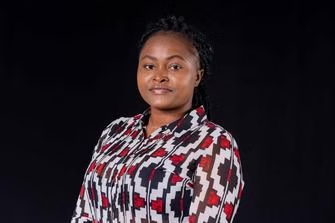
A Zimbabwean journalist on why environmental reporting only shows up after disaster, and the newsroom she built to cover everything that happens in between.
The Trigger Problem
Most environmental coverage in Southern Africa focuses on the same thing. A cyclone lands, a river floods, a drought gets bad enough, and for a week or two it's a story. Then the cameras abruptly leave. Shorai Murwira's career has been an argument against that pattern, and in 2022 she turned the argument into a publication. She founded The Southern Environment because some stories almost never get told: what a drought does to a household over the following two years, or what a community builds after the flood recedes. "Climate change is shaping people's lives every day, especially in rural communities," she says, "and those slower, less visible stories were being overlooked." The platform covers adaptation, conservation, governance, renewable energy and food security alongside the disasters, and trains young journalists and community storytellers to report from inside their own communities rather than sending reporters in from elsewhere.
From General Reporter to Climate Reporter
Shorai Murwira studied Media and Cultural Studies at Great Zimbabwe University and started out as a general reporter, taking whatever assignments came her way. Time in rural communities changed how she saw the job. Stories editors filed under "development" or "human interest" (families losing harvests to drought, women walking longer distances for water, communities displaced by flooding) were climate stories that nobody was labelling as such. That gap became the rest of her career. She has since reported on climate change, biodiversity, water and environmental justice for local and international outlets, and won an Africa Gender Award in 2021 for her reporting on climate justice, which she says deepened her commitment to putting people at the centre of environmental stories.
People, Not a Dataset
Murwira's method starts with a person, not a dataset. She isn't dismissive of the science, but she thinks people connect to other people first, so she spends time in a community listening before she writes anything. "I always try to understand how environmental issues affect someone's daily life before looking at statistics or policy," she says. Photography and documentary work do similar work in her reporting. An image can carry urgency or grief in a way a paragraph sometimes can't.
She's also committed to what's often called solutions journalism, though she doesn't use the term like a slogan. Coverage that only shows the damage leaves audiences with nowhere to put their attention. Coverage that also shows communities adapting gives people something to learn from, or root for.
Mutoko
Mutoko is the example she returns to. After repeated droughts left the land degraded, a group of women didn't wait for outside help. They cleared it themselves, adopted climate-smart farming, installed solar-powered irrigation, and started growing vegetables and traditional grains again. Murwira documented what followed: household incomes rising, food security improving, and, less predictably, some of the social pressure around gender-based violence and child marriage easing as the community stabilised. "What struck me wasn't only their resilience," she says, "but how climate adaptation was changing entire communities."
Women Carry the Burden and Lead the Response
A large share of her reporting focuses on women and girls, and the pattern is often the same: when drought hits, women walk further for water. When harvests fail, mothers eat last. When money runs short, girls are the first pulled from school. Economic strain from climate change has also been tied to increases in child marriage and gender-based violence in the communities she covers. The same women absorbing that burden are, in her experience, also running some of the most effective adaptation work she's covered: farming cooperatives that restore degraded land, manage local water supplies, and bring in climate-smart techniques well before any programme tells them to. "Women shouldn't only be portrayed as victims of climate change," she says. "They are also leaders, innovators, and agents of change."
What Zimbabwean Media Misses
Pressed on what Zimbabwean media gets wrong, Murwira points to everything that happens too slowly to be a headline: biodiversity loss, wetland destruction, illegal sand mining, river pollution, deforestation, and land degradation. All of it compounds for years with barely any coverage, while a single flood gets weeks of attention.
There's also a question of who gets to talk. She thinks environmental coverage leans too heavily on experts in conference rooms and not nearly enough on the farmers, women and young people actually living through the changes. Adaptation stories (the local solutions communities have built on their own) get a fraction of the airtime a disaster does, despite often being the more useful story for anyone trying to understand how a community actually copes.
Where She's Taking The Southern Environment
Murwira wants The Southern Environment to grow past being a newsroom in the conventional sense. Her goal is to create a hub for investigative reporting, documentary work and photography, with training for the next generation of climate journalists built in. Mentoring young reporters from underserved communities matters to her specifically because she thinks inclusive environmental coverage depends on who's allowed to report it in the first place, not just who it's about.
She has also stated that her goal is a public that understands climate change better, environmental governance that actually holds up, and policy that reflects what communities are dealing with rather than what looks good in a briefing. "Environmental journalism isn't just about reporting on nature," she says. "It's about documenting people's relationship with the environment and ensuring that those most affected by climate change have their stories heard."
This piece is based on an interview with Shorai Murwira, founder of The Southern Environment.
Thank you to Shorai Murwira for her time and generosity in sharing these stories.