How one self-taught Malawian photographer turned a wedding photography side hustle into a documentary career, capturing flood survivors, hospital wards, and the development stories nobody else is recording.
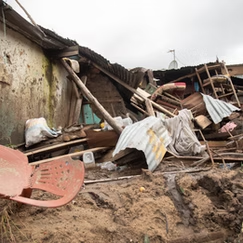
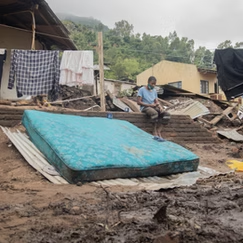
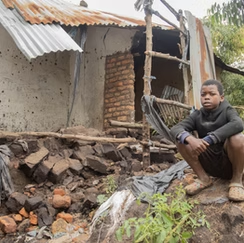
A family stands silently on the edge of a riverbank in southern Malawi. Just a day earlier, this was their home. Their possessions, furniture, savings, and sense of security were all swept away by floodwaters. Nothing remains except the clothes they are wearing.
For Malumbo Simwaka, standing behind the camera, the scene needed no explanation. "The photograph should tell a story by itself," he says. This belief has shaped his career for over a decade. He has moved from wedding photography to documenting some of Malawi's most pressing social issues. His images help NGOs raise funds, communicate their impact, and connect distant audiences with realities they may never see. In a sector driven by storytelling, photographers like Simwaka often bridge the gap between communities on the ground and donors thousands of kilometers away.
From Hobby to Profession
Malumbo's path into photography was unconventional. It began as a hobby during his school years. Whenever he returned home for holidays, he experimented with a camera and film, developing an interest that would one day become his career. By 2009, he started assisting professional photographers, learning through observation and experience. The following year, he committed fully to photography as a full-time profession. At that time, professional photography in Malawi was still developing, and opportunities were there for photographers willing to build a reputation through quality work. Malumbo focused primarily on weddings and portraits, steadily establishing himself in the industry. He had no formal training; instead, he taught himself through online resources, particularly YouTube. He studied the work of international photographers and learned techniques on his own. When questions arose, he reached out to photographers through social media, seeking advice from those whose work he admired. "I didn't go to school to learn photography," he explains. "YouTube played a big role in my life."
Turning Towards Social Impact
Around 2015, something shifted. Although weddings and commercial photography provided work, Malumbo found himself increasingly drawn to stories with a broader social purpose. He began focusing on humanitarian and development photography, documenting communities, health programs, education initiatives, and everyday life across Malawi. This transition marked a new chapter for Amaru Photography, the brand he established years earlier.
Capturing Life as It Happens
Instead of creating staged images, Malumbo prioritizes authenticity. His approach is simple: observe, follow, and document. For example, he captures a child preparing for school, a family carrying out daily routines, healthcare workers moving through a hospital ward, or farmers tending their fields. The goal is not to direct events but to simply witness them. "I want to photograph people the way they are and how they are doing their things," he says. "It has to be natural." His images are rarely staged, and subjects often are unaware of the exact moment they are being photographed. The aim is to capture life as it happens and allow viewers to step into that reality. The result is photography that feels more like a story than just a portrait, offering insight into people's lives rather than merely recording their appearance.
Why NGOs Need Visual Storytelling
For many NGOs, photography serves a purpose beyond just documentation. Development organizations rely on stories to show need, communicate impact, and secure funding. Sometimes, a single photograph becomes the first point of contact between a donor and a community they have never visited. Malumbo understands this responsibility well. "For them to help, they have to see," he says. "And who's going to provide that photograph? Me." Behind that simple statement lies an important truth. Before a donor reads a report, reviews statistics, or looks over a proposal, they often see an image first. A photograph can communicate urgency, resilience, hardship, or hope in an instant. It can prompt curiosity, empathy, and action. In many cases, funding begins with visual storytelling. For Malumbo, creating those images means finding moments that clearly communicate a reality, making words secondary.
Documenting the Aftermath of Cyclone Idai
Perhaps no project illustrates this better than his work following Cyclone Idai. In 2019, severe flooding and storms devastated communities across southern Malawi, destroying homes, infrastructure, and livelihoods. While organizations mobilized emergency responses, Malumbo started a personal project to document conditions on the ground. Without a commission or assignment, he travelled to several of the hardest-hit areas, arriving while many communities were still facing the immediate aftermath. What he witnessed has remained with him. Entire homes had vanished. Families who had gone to sleep with shelter woke up to find rivers where houses once stood. "The only thing that was remaining was the clothes they were wearing," he recalls. The photographs he captured were later used by multiple NGOs to support fundraising efforts and emergency appeals.
When Images Lead to Action
For Malumbo, however, the lasting impact went beyond producing images. It was seeing those images lead to real support for people in need. "It is very fulfilling," he says, "that you've taken a photograph of someone who was in need, and by the end of the day, someone comes and helps that person, and you see a smile on that person." His work highlights the often-overlooked role photographers play in humanitarian responses. While aid workers distribute supplies and communities rebuild, photographers create a visual record that helps maintain public attention and support.
The Stories That Never Get Told
One of the most striking parts of our conversation wasn't about crisis or disaster. It was about success. According to Malumbo, many of Malawi's essential development stories are never documented. Projects are completed and lives improve. Yet those transformations often go unseen.
Picture this: a student receives a bursary, completes their education, and secures employment. A health program improves outcomes in a rural area. A livelihood project enables families to increase their incomes. These impacts all exist, but the documentation does not. "Some projects don't have a budget for this," he explains. "And they don't prioritize documenting it."
The consequences go beyond storytelling. Without evidence of success, organizations struggle to show impact, attract future funding, and share lessons with others. Stories that could inspire support and confidence just disappear.
Looking Ahead: New Challenges, New Stories
As international funding pressures continue to affect NGOs across Malawi, Malumbo is increasingly focused on self-initiated projects that tackle emerging challenges. His current priorities include work in health, documenting needs, and highlighting opportunities for support from local businesses and communities alongside traditional international donors. He is also developing projects centred on agriculture and agribusiness, sectors crucial to Malawi's economy and rural livelihoods.
Neither project came from a client. Both come from the same principle that has guided his work for the past decade: important stories deserve to be told, even when nobody has commissioned them.
Building Connections Through Photography
This principle captures the essence of Malumbo Simwaka's work. The camera is simply a tool. The real purpose is creating connections between people who may never meet, helping distant audiences understand far away realities, and ensuring that stories of resilience and progress are not forgotten.
Why Stories Matter
Perhaps the biggest lesson from Malumbo's work is that development isn't only about delivering projects, building infrastructure, or securing funding. It's also about making sure people's experiences are seen, understood, and remembered. Stories can build empathy, attract support, and show the impact change can have on lives. Beyond photography and international development, this message applies to everyday life. It reminds us to pay attention to the stories unfolding around us, to listen to people's experiences, and to recognize that small actions can make a meaningful difference. It also encourages us to notice progress, not just problems. Too often, we focus on what is going wrong while ignoring positive change. Whether in our studies, careers, families, or communities, acknowledging growth and sharing success stories can inspire others and help create a stronger sense of connection. As Malumbo's work shows, behind every statistic is a person, behind every project is a story, and sometimes a single image, conversation, or act of kindness can express that reality more powerfully than pages of reports ever could.
Final Reflections
Conversations like this are exactly why I started this platform. My goal is to highlight the people, ideas, and stories shaping communities across Africa and beyond, particularly those that often receive little international attention. Malumbo's work sits at the intersection of storytelling, development, and social impact, showing how one person's skills can help amplify voices, document change, and connect communities with opportunities for support. It was a privilege to speak with someone so deeply committed to using his craft in service of others, and I am grateful that he took the time to share his experiences. If this interview demonstrates anything, it is that meaningful change is often driven not by large institutions alone, but by individuals who choose to document, share, and tell the stories that matter.
This interview is part of an ongoing series highlighting people and stories from across Africa that rarely get international attention. Malumbo Simwaka's work sits at the crossroads of photography, development, and storytelling, and it was a pleasure to talk with him about it. Thanks to him for making time despite a packed schedule.
Connect with Malumbo Simwaka:
Instagram ·
LinkedIn ·
amaruphotography.com ·
malumbo_simwaka@yahoo.co.uk
Listen to part of the interview with Malumbo →